
Disclaimer: This is a prototype page for demonstration purposes only. The information on this page may be inaccurate or out of date and should not be relied upon to make application or career decisions.
University of Aberdeen
School of Medicine
Begin your path to medicine with guidance and insights into this renowned Scottish institution
Instant access
At a glance
Learning mode
On campus/placement
Study mode
Full time
Duration
5 years
Degree qualification
MBChB
Course start
September 2026
UCAS code
A100
GMC accredited?
Yes
A little bit about Aberdeen's School of Medicine
The University of Aberdeen’s School of Medicine is located in the city of Aberdeen in the North East of Scotland. With a population of approximately 195,000 people, it is the third largest city in Scotland. The University of Aberdeen has a distinguished history of medical education, beginning with the founding of King’s College in 1495, which established the first chair of medicine in the English-speaking world in 1497. A more formal medical school emerged around 1787. In 1860, the merger of King’s and Marischal Colleges formed the modern university.
Aberdeen has nurtured pioneering figures like Sir Patrick Manson (graduated 1865), known as the “Father of Tropical Medicine” for his groundbreaking work on vector-borne diseases. Another eminent alumnus, Professor J. J. R. Macleod, was jointly awarded the 1923 Nobel Prize in Physiology or Medicine with Frederick Banting for their research leading to the development of insulin as a treatment for diabetes. Today, the School of Medicine, Medical Sciences & Nutrition is based at the Foresterhill Health Campus, one of Europe’s largest medical sites, continuing its legacy of world-class research, education, and healthcare.
Where does Aberdeen rank for medicine?
1st
The Guardian University Guide
10th
The Times University Rankings
16th
The Complete University Guide
Aberdeen’s Medical School has achieved impressive rankings in several prominent university guides for 2025. It secured the top position (1st out of 38) in The Guardian University Guide for Medicine. In The Times UK University Rankings League Table, it placed 10th out of 39 medical schools. Furthermore, The Complete University Guide ranked Aberdeen 16th out of 39 for medicine.
While each guide employs distinct methodologies for assessment, leading to variations in rankings, Aberdeen consistently performs strongly, demonstrating that it compares favourably to other UK medical schools.
How happy are students with their course?
82%
National Student Survey 2024
Student satisfaction for medicine at Aberdeen stands at 82%, reflecting students’ views on teaching quality. This figure is derived from the 2024 National Student Survey (NSS), which surveys final-year undergraduates on various aspects of their teaching experience. While it provides valuable insight into student opinion, it’s important to note it’s not a direct measure of quality and can be influenced by student expectations.
How do you get into Aberdeen?
There are a range of academic and non-academic requirements that candidates need to fulfill in order to be considered for a place to study medicine at the University of Aberdeen.
The School of Medicine evaluates applicants using a three-pronged approach, with each component carrying a specific weight. Your UCAT score accounts for 20% of your overall assessment, while your academic achievements and predictions contribute 30%. The interview score is the most significant factor, making up the remaining 50%.
The application process unfolds in two key stages. Initially, candidates are invited for an interview based on a combined assessment of their UCAT score and academic performance. Those who achieve the highest scores in these two areas proceed to the interview stage. Finally, offers to study medicine are extended to the candidates who demonstrate the strongest overall performance across all three categories: UCAT score, academic achievements, and interview.
UCAT Scores
Lowest UCAT score invited to interview
Average UCAT score interviewed
Lowest UCAT score made an offer
School leavers
2160
2560
2160
Graduates
2180
2580
2180
Lowest UCAT score invited to interview
Average UCAT score interviewed
Lowest UCAT score made an offer
School leavers
2440
2700
2440
Graduates
2400
2600
2400
Lowest UCAT score invited to interview
Average UCAT score interviewed
Lowest UCAT score made an offer
School leavers
2390
2700
2400
Graduates
2390
2630
2450
Here are some of the UCAT thresholds of candidates who applied in 2024 and were invited to interview and/or offered a place to study medicine. This is a tabbed table so be sure to select the category you fall in to access the most relevant data. The scores required will invariably change from year to year and the data presented is intended to provide insight but not guidance.
General Entry Requirements
Scottish Qualifications Authority
Standard: AAAAB at Highers taken at one sitting. Chemistry is required, plus two from Biology/Human Biology/Mathematics and Physics.
Adjusted: AAAB for applicants who meet one or more widening access criteria. Chemistry is required, plus two from Biology/Human Biology/Mathematics and Physics.
Foundation Apprenticeship: We will accept the FA Social Sciences & Healthcare as equivalent to an A at Higher in a science subject and the FA Scientific Technology as equivalent to an A at Higher in a non-science subject.
NOTE: N5 in both English and Mathematics at grade B or above required. N5 Biology and Physics are recommended (at grade B or above) but not compulsory.
A Levels:
Standard: 3 A Levels at AAA. Chemistry is required, plus one from Biology, Mathematics or Physics, and one other subject.
GCSE if both English Language and Mathematics at grade 6/B. GCSE Biology and Physics recommended (grade 6/B or above).
International Baccalaureate:
Minimum of 36 points including at least 3 HL at 6 and 3 SL with an average of 6.
HL Chemistry is required; plus HL in Maths, Biology or Physics, and one other subject.
If only 2 sciences offered at HL, must have a further science subject at SL.
Irish Leaving Certificate:
3 Higher subjects at Grade H1 including Chemistry, Biology and one other subject.
3 Higher subjects at Grade H2 including English and either Maths or Physics, plus one other subject.
The tabbed table above provides a summary of entry requirements. For the full details click here to access the University of Aberdeen’s website for UK, Graduate, EU and International candidates.
The Aberdeen interview

Format
Multiple Mini Interviews
Number of stations
To be certified
Assesors per station
At least two
Time per station
Five minutes
The Aberdeen interview is a key part of the application process. It’s a Multiple Mini Interview (MMI) format, with 5 minutes allocated per station. While professional attire is recommended, the overall tone of the interview process is designed to be a constructive assessment of your potential. Please ensure you complete the consent and fitness forms that will be sent via email before your interview. If you need reasonable adjustments, submit the necessary form at least five days beforehand.
The interview will explore: Motivation to study medicine, Core Qualities, Critical thinking & problem-solving, Teamwork, and Professionalism. There may also be a further pilot station. A significant focus is placed on whether candidates have thoroughly researched the undergraduate curriculum, postgraduate training, and the practical implications of a medical career. This demonstrates a well-considered decision to pursue medicine, extending beyond just your personal experiences. Interviewers are interested in understanding your genuine insights and appreciation for the profession.
Your performance will be assessed on your ability to clearly express ideas, form reasoned opinions, demonstrate your preparation, and discuss various aspects of a problem. Strong communication and interpersonal skills are also important. To prepare effectively, engage in comprehensive research into healthcare careers, reflect on your understanding of the profession, and practice answering
Medical School Interview Course
Online Course £159
How hard is it to get in?
Securing a medical school place is challenging globally, and Scotland is no different. The level of difficulty in securing a place, however, depends on your applicant group. The University of Aberdeen’s School of Medicine considers three main categories: Home students, Rest of UK (RUK) students, and International students.
Places
254
Home students
25
Rest of UK (RUK) students
19
International students
For Aberdeen’s 2024 entry, the available places were 254 for home students, 25 for those from the rest of the UK (RUK), and 19 for international students. The actual intake for that year saw 224 home students, 55 RUK students, and 37 international students. Admissions data, including places and intake figures, typically shows some variation year on year.
Competition ratios
Applicants per place
Applicants per interview
Home
3.25
1.09
Rest of UK
11.84
1.65
International
13.79
2.28
Home students typically encounter a comparatively lower degree of competition, both at the invitation to interview stage and when receiving an offer of a place, relative to applicants from the Rest of the UK (RUK) and international backgrounds. This often stems from larger allocated quotas for domestic students, influenced by national educational priorities and funding structures. While being invited for an interview inherently places you in a smaller, more focused pool, it is crucial to recognize that the candidates you are now competing against represent a highly pre-qualified group. These individuals have already demonstrated exceptional academic profiles and strong suitability for the program, having successfully navigated initial screening processes.
The Aberdeen medicine course
The curriculum
The Aberdeen medical curriculum is structured over five years, progressing from foundational sciences and early clinical skills (Years 1-2), to detailed system-based learning with increasing clinical attachments and professional practice (Year 3). Year 4 emphasizes Senior Clinical Practice through intensive, varied clinical blocks. The final Year 5 is an “apprentice year,” focusing on professional practice, an elective, and preparing students for their role as Foundation Doctors, integrating knowledge into whole-patient care.
Year 1 establishes foundational medical knowledge, encompassing normal human function, disease principles, and General Practice. Anatomy introduces human structure and terminology. Clinical Skills training begins, covering practical and communication abilities, including emergency management. Term 2 introduces the Respiratory and Cardiovascular Systems, with continued anatomical focus and students’ first clinical attachments. The GP Enhanced programme offers community-based learning, and a Student Selected Component (SSC) allows in-depth topic exploration.
Year 2 continues the systemic study in Medicine 2, covering the Alimentary, Head/Neck/Dermatology, and Nervous systems. Anatomy and Clinical Skills teaching persists, with extended resuscitation practice and ongoing General Practice instruction. A second Student Selected Component (SSC) provides another opportunity for in-depth study before the curriculum addresses Diabetes/Endocrine and Urinary Systems. The year concludes with Advanced Infection, the Musculoskeletal system, and Medical Ethics & Law, broadening the scope of medical and professional understanding.
Year 3 commences with the Reproductive System, followed by a 6-week Medical Humanities course for specialized topic selection. Specialties and Professional Practice teaching then covers areas like Medicine of Old Age and Clinical Genetics, alongside continued General Practice. Term 2 includes Psychiatry, Haematology/Immunology, and Paediatrics. Extensive bi-weekly clinical attachments lead to proficiency in complete patient examinations. The year concludes with an SSC on Clinical Effectiveness, exploring public health aspects of medicine.
Year 4, designated Senior Clinical Practice, is a clinically-intensive experience focusing on clinical reasoning and management skills for diverse patient populations. Students undertake seven six-week clinical blocks across various disciplines, including Acute Medicine, Surgery, and Mental Health. At least one block is undertaken in Inverness, with a comprehensive remote and rural option available. Five horizontal themes—diagnostics, end of life care, health data science, quality improvement, and cost/value of healthcare—are integrated throughout the curriculum.
Year 5, Professional Practice, signifies a shift to active participation as a clinical team member, preparing students as Foundation Doctors. It features three 8-week clinical attachments in Medicine, Surgery, and Community Health, focusing on generic core skills. This “apprentice year” involves significant practical engagement. An 8-week project-based Elective allows self-arranged specialized study. The Professional Practice Block, split across the year, facilitates the student-to-doctor transition, addressing practical issues like ethics, careers, and workplace stress.
Aberdeen seeks candidates who demonstrate informed understanding of its curriculum, the overall course, and the realities of a medical career, reflecting diligent research and genuine commitment.
How students learn
Clinical learning
Professional placements
E-Learning
Lectures and seminars
Peer learning
Group projects
Research
Tutorials
At Aberdeen, medical students engage in a varied learning approach. This includes traditional lectures and seminars alongside modern e-learning, peer learning, and collaborative group projects.1 Crucially, learning is highly practical, incorporating extensive clinical learning and professional placements from early years.2 Research opportunities and focused tutorials further enhance the integrated, systems-based curriculum, ensuring a comprehensive educational experience.
Let's talk money
Tuition fees for 2025/26
£1,820
Home students
£9,535
Rest of UK (RUK) students
£50,100
International students
Annual tuition fees differ by status. Scottish Home students pay approximately £1,820, while Rest of UK (RUK) students are charged around £9,535. International students face significantly higher fees, typically about £50,100 per year, which includes a national levy for clinical teaching. It’s important to note that fees at many institutions often increase annually. Furthermore, these stated fees generally cover tuition only and do not include additional study materials like key textbooks, personal medical equipment (e.g., stethoscopes), or living expenses.
Cost of living
£1,023
The University of Aberdeen suggests budgeting £1,023 monthly for living costs, covering accommodation, food, transport, and personal expenses, though actual costs vary. The UK has seen rapidly rising living costs, with inflation significantly impacting essentials. International medical students should also account for additional expenses such as visa fees and the Immigration Health Surcharge, reflecting the comprehensive financial planning required for studying in Scotland.
Location
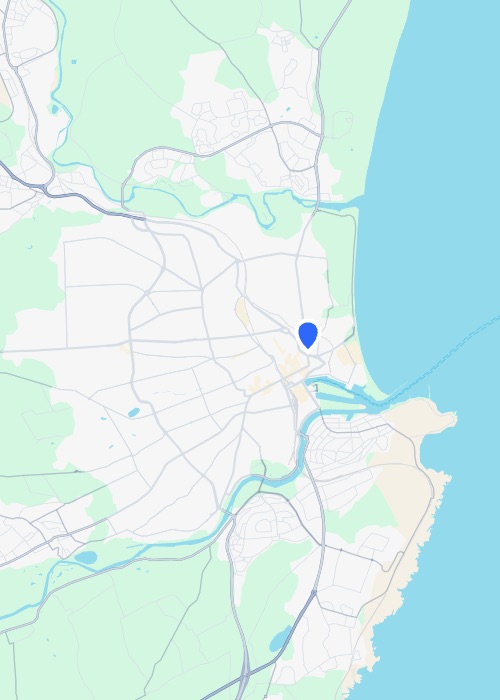
Aberdeen is a significant city on Scotland’s northeast coast, approximately 120 miles north of Edinburgh, the capital, and 400 miles north of London.
For university students, Aberdeen offers a lively social scene. Nightlife includes pubs like Ma Cameron’s and live music at The Blue Lamp. Students can join numerous university societies and sports clubs (over 100), from A Cappella to rock climbing, ideal for meeting new people. Beautiful beaches and parks also provide great outdoor social opportunities.
To travel from Aberdeen to Edinburgh, direct trains (ScotRail, LNER) take around 2.5 hours. Buses (Megabus, FlixBus) are also available, usually taking 3 hours and often cheaper for students.
For journeys to London, flying from Aberdeen International Airport (ABZ) is quickest, at about 1.5 hours. Direct trains (LNER, Caledonian Sleeper) offer a longer route (7-8 hours), while buses (Megabus, FlixBus) are the most economical option, typically lasting 11-13 hours.
Medical School Interview Course
Online Course £159